

CURTISS, Betty Ruth
CURTISS, Betty Ruth
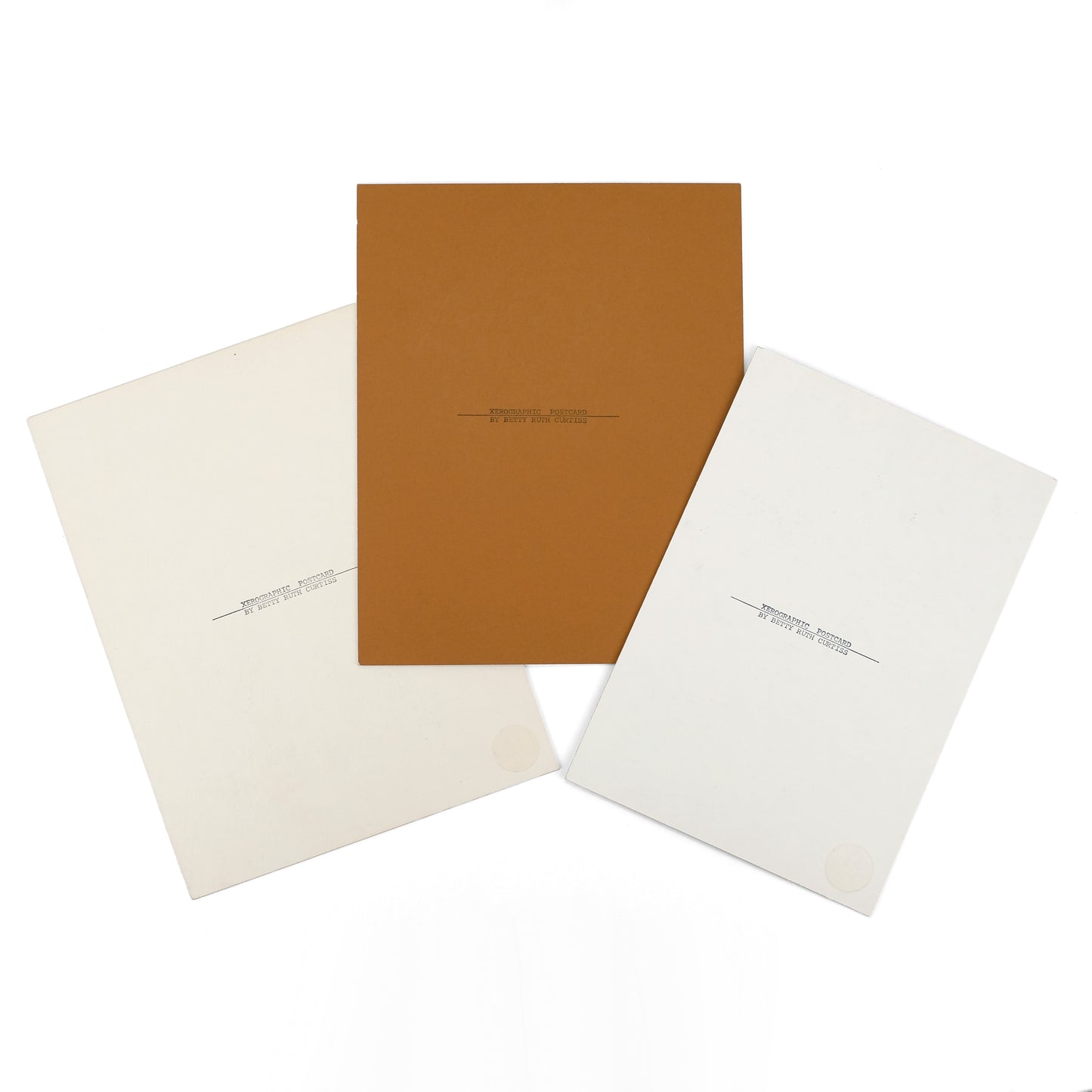
[Princeton, NJ]: Betty Ruth Curtiss, [circa late 1970s or 1980s]. 3 board-mounted xerographic prints, two color (10-3/4 x 8-1/4 and 10-1/8 x 7-1/8 in.) and one black-and-white (10-3/8 x 8-1/4 in). Each titled in typescript to verso: "Xerographic Postcard by Betty Ruth Curtiss." Light edgewear, 1" circular pricing stickers to versos; near fine.
Three xerographic prints by American artist Betty Ruth Curtiss (1931-1985), an "original in the Emersonian vein" as Patricia Malarcher dubbed her in a 1987 New York Times review of her posthumous show at Franklin Furnace. Curtiss was a notable early adopter of Xerox technology as an artistic mode, and frequently incorporated the detritus of everyday life into her work—both of which strains are nicely demonstrated in the present prints, one of which depicts a fraying piece of cloth, another a halved cabbage. In a June 2025 interview with Roberta Fallon of artblog.org, Richard Torchia summarized Curtiss's work thus:
"Betty Ruth’s practice was grounded in found objects and immediate processes, including rubber stamping, mail art, and xerography, which she had initially employed as a way to document the necklaces she made. ... In her backyard she maintained a set of instruments she’d produced from street finds. Among them was a xylophone she had constructed from pieces of wood of various lengths resting on parallel rows of bicycle inner-tubes, which allowed them to resonate surprisingly well, as anyone with the curiosity to play would discover. She also cultivated a number of small collections, including chewed gum and found combs, as well as lost gloves, which she presented on a wooden card rack on the family’s front porch in Princeton where neighbors might find or deposit them. She also collected laundry lint from her own dryer, which had a circular lint screen. A stack of about 300 of these was included in the show [a 1986 retrospective at City Without Walls] along with examples of her work in other mediums, which a year later was presented at Franklin Furnace in New York...."
Scarce work; we find no other examples of Curtiss's prints in the trade, and locate no holdings via OCLC.
Couldn't load pickup availability